
Let me guess — you’ve heard the word “SEO” thrown around about a hundred times, but every time you try to look it up, you end up more confused than when you started. Ranking signals, backlinks, meta tags, crawl budgets… It sounds like a foreign language.
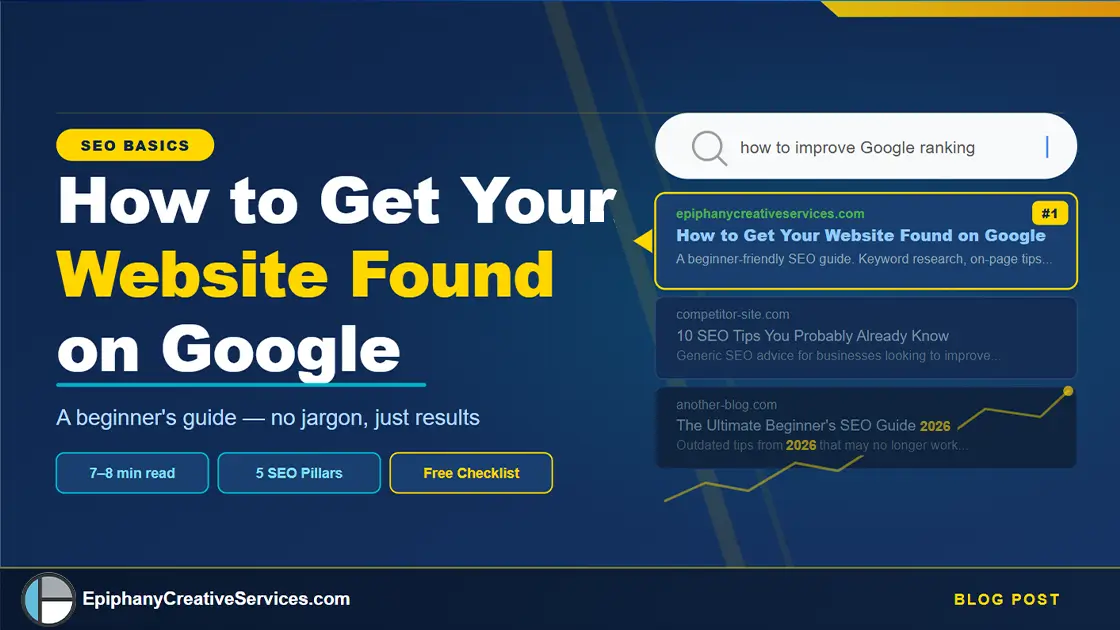
Here’s the truth: SEO doesn’t have to be complicated. At its core, it’s just about making your website easy for Google to understand — and making sure it answers what your potential customers are actually searching for.
In this guide, I’m going to strip it all back and walk you through the fundamentals. No fluff, no jargon — just what you need to know to start showing up on Google and bringing in the kind of traffic that actually matters.
1. What Is SEO and Why Does It Matter?
SEO stands for Search Engine Optimization. In simple terms, it’s the process of improving your website so that Google (and other search engines) rank it higher in search results when people search for topics related to your business.
Think about your own habits for a second. When you search for something on Google, how often do you scroll past the first page of results? Almost never, right? Most people don’t. In fact, the top three results on Google get over 50% of all clicks for any given search.
That’s why SEO matters. If your website isn’t showing up on page one, you’re essentially invisible to the people who are actively looking for exactly what you offer.
2. How Does Google Actually Work?
Before you can optimize for Google, it helps to understand how it works. Google uses automated programs called “crawlers” or “spiders” to browse the web and discover new pages. When a crawler finds your page, it reads the content, follows your links, and stores the information in a massive database called the Google Index.
When someone searches for something, Google looks through its index, figures out which pages are most relevant and trustworthy, and then ranks them accordingly. The algorithm takes hundreds of factors into account — but for beginners, there are just a few core areas that move the needle most.
3. The 5 Core Pillars of SEO for Beginners
Pillar 1: Keyword Research — Know What People Are Searching For
Keywords are the words and phrases people type into Google. If your website’s content doesn’t include those words, Google has no idea you’re relevant — and you won’t show up.
Start by thinking about your business from your customer’s perspective. If someone wanted to find what you offer, what would they type? Those are your keywords.
Some practical tips for keyword research:
- Use free tools like Google’s autocomplete — just start typing and see what Google suggests
- Try Google Search Console (free) to see what searches are already bringing people to your site
- Look at the “People also ask” boxes in Google search results — goldmine for content ideas
- Focus on long-tail keywords (longer, more specific phrases) — they’re less competitive and often more targeted
Pillar 2: On-Page SEO — Optimizing What's Already on Your Site
On-page SEO is everything you do on the pages of your website to help Google understand what they’re about. This is the most directly controllable part of SEO, and it’s where most beginners should start.
The key elements of on-page SEO:
- Page titles (Title Tags): The clickable headline that appears in Google search results. Include your main keyword here — it’s one of the strongest signals you can give Google.
- Meta descriptions: The short summary under the title in search results. Write it like an ad — make people want to click.
- Headings (H1, H2, H3): Use headings to structure your content. Your H1 is your main page title — use it once, and include your primary keyword.
- URL structure: Keep URLs short and descriptive. /seo-basics is better than /page?id=2847.
- Image alt text: Every image should have a description that tells Google what it shows. This helps both SEO and accessibility.
- Internal links: Link from one page on your site to another. It helps Google crawl your site and keeps visitors engaged longer.
Pillar 3: Content — The Most Important Ranking Factor
Google’s entire mission is to give people the most helpful, relevant answer to their search. That means the websites with the best content win. Period.
But what does “good content” actually mean in Google’s eyes?
- It answers the question the searcher was asking — completely and clearly
- It’s written for humans, not search engines (no keyword stuffing)
- It’s original — don’t copy content from other sites
- It’s regularly updated — stale content loses rankings over time
- It’s longer and more detailed than competing pages on the same topic
Pillar 4: Technical SEO — Making Your Site Easy to Crawl
Technical SEO covers the behind-the-scenes stuff that affects how well Google can access, crawl, and understand your website. You don’t need to be a developer to handle the basics, but you do need to be aware of them.
The most important technical SEO factors for beginners:
- Site speed: A slow website hurts rankings. Google wants to send people to pages that load fast. Test yours at PageSpeed Insights (free tool by Google).
- Mobile-friendliness: More than half of all searches happen on mobile devices. Your website must look and work great on phones.
- HTTPS: As covered in a previous post — you need an SSL certificate. Google flags non-HTTPS sites as “Not Secure” and ranks them lower.
- Sitemap: A sitemap is a file that tells Google about all the pages on your site. Most website platforms generate this automatically.
- No broken links: Broken links frustrate users and confuse Google crawlers. Run a free check with tools like Screaming Frog.
Pillar 5: Backlinks — Building Your Website's Authority
A backlink is when another website links to yours. Think of each backlink as a vote of confidence — Google sees it as other sites saying “hey, this content is worth reading.”
The more high-quality backlinks your site has, the more authority Google gives it — and the higher it tends to rank.
How do you build backlinks as a beginner?
- Create genuinely useful content that people want to share and reference
- Write guest posts for other blogs or websites in your industry
- Get listed in local directories and industry-specific listings
- Ask partners, suppliers, or clients to link to your site
- Create shareable resources — guides, tools, checklists, infographics
One thing to be careful about: avoid buying cheap backlinks from shady services. Google has become very good at detecting this, and it can actually hurt your rankings or result in a penalty.
4. Local SEO — Essential If You Serve a Specific Area
If you’re a local business — a restaurant, a service provider, a retail shop — local SEO is arguably the most important thing you can do. This is about making sure your business shows up when someone nearby searches for what you offer.
The three most important steps for local SEO:
1) Claim and fully complete your Google Business Profile (formerly Google My Business). This is the box that appears on the right side of Google search results with your address, hours, photos, and reviews. It’s free, and it’s incredibly powerful.
2) Make sure your business name, address, and phone number (NAP) are consistent everywhere they appear online — your website, social media, directories, and listings.
3) Collect reviews. Google reviews are a major local ranking factor. Ask your happy customers to leave one — a simple follow-up email or text can go a long way.
5. How Long Does SEO Take to Work?
This is the question everyone asks — and the honest answer is: it depends. But let’s give you some realistic expectations.
For a brand new website with no existing authority, you’re typically looking at 3 to 6 months before you start seeing meaningful organic traffic from SEO. For more competitive keywords in crowded industries, it can take 6 to 12 months or more.
That doesn’t mean you won’t see any progress sooner. On-page improvements can sometimes show results within weeks. But SEO is a long game, and the businesses that commit to it consistently are the ones that end up dominating their market.
6. Common SEO Mistakes to Avoid
Before we wrap up, here are some of the most common mistakes that hold small business websites back from ranking:
- Ignoring mobile users — if your site isn’t mobile-friendly, you’re losing rankings and customers
- Keyword stuffing — repeating keywords unnaturally makes your content unreadable and gets you penalized
- Duplicate content — having the same (or very similar) content on multiple pages confuses Google
- Skipping the basics — many sites don’t even have proper title tags or meta descriptions set up
- No patience — giving up after a few weeks and declaring SEO “doesn’t work”
- Neglecting Google Analytics and Search Console — if you’re not tracking what’s happening, you can’t improve it
Your SEO Quick-Start Checklist
If you’re just getting started, tackle this list first:
- Install Google Analytics and Google Search Console on your site
- Make sure your site is on HTTPS
- Run your site through PageSpeed Insights and fix any major issues
- Confirm your site is mobile-friendly
- Write a unique, keyword-rich title tag and meta description for each page
- Set up or claim your Google Business Profile if you’re a local business
- Start a blog and publish at least one helpful, keyword-targeted post per week
- Build your first 5–10 backlinks through directories and partnerships
Feeling Overwhelmed? You Don't Have to Do This Alone.
Look — SEO is one of those things that sounds simple in theory but gets complicated fast in practice. Between keyword research, content strategy, technical fixes, and link building, there’s a lot to manage — and it changes constantly as Google updates its algorithm.
Most business owners don’t have the time to become SEO experts. That’s not a failure — that’s just reality. What you need is someone who lives and breathes this stuff and can take it off your plate entirely.
At Epiphany Creative Services, we specialize in building websites that don’t just look beautiful — they’re built from the ground up to rank. We handle everything: the technical setup, the content strategy, the on-page optimization, and the ongoing management.