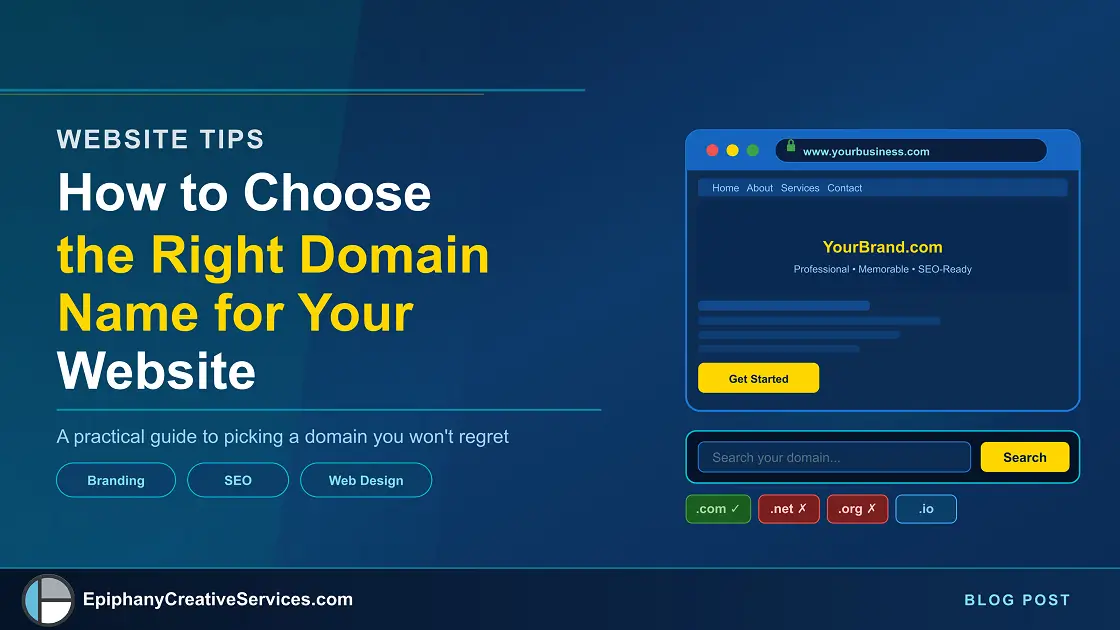

Let’s be honest — choosing a domain name feels simple until you actually sit down to do it. You type in your ideal name, and it’s taken. You try a variation, and it looks weird. You settle for something with a hyphen in it, and then someone tells you that’s bad for SEO.
Sound familiar?
Your domain name is one of the first things people see about your business online. It’s on your business cards, in your email address, and it’s what people type when they want to find you. Getting it right matters more than most people realize — and getting it wrong can follow you for years.
In this guide, I’m going to walk you through exactly how to choose a domain name that works for your brand, your visitors, and yes — Google too.
1. Keep It Short and Simple
This is rule number one for a reason. The shorter your domain name, the easier it is to remember, type, and share. Aim for somewhere between 6 and 14 characters if you can manage it.
Think about some of the most successful websites in the world — Amazon, Google, Apple, Stripe. Short, punchy, and impossible to misspell. That’s what you’re going for.
Quick rule of thumb:
If you have to spell it out every time you say it out loud, it’s probably too complicated.
Long domain names aren’t just harder to remember — they’re also harder to fit on marketing materials, and they look cluttered in email addresses. Keep it tight.
1. Keep It Short and Simple
This is rule number one for a reason. The shorter your domain name, the easier it is to remember, type, and share. Aim for somewhere between 6 and 14 characters if you can manage it.
Think about some of the most successful websites in the world — Amazon, Google, Apple, Stripe. Short, punchy, and impossible to misspell. That’s what you’re going for.
Quick rule of thumb:
If you have to spell it out every time you say it out loud, it’s probably too complicated.
Long domain names aren’t just harder to remember — they’re also harder to fit on marketing materials, and they look cluttered in email addresses. Keep it tight.
2. Make It Easy to Spell and Say
Your domain name needs to work in two worlds: the written world and the spoken world. If someone hears your business name on a podcast or in conversation, they should be able to Google it without second-guessing the spelling.
Watch out for these common traps:
- Words with unusual spelling (like “phishing” or “knack”)
- Homophones — words that sound like other words (“there” vs “their”)
- Numbers or symbols — does “4” mean “for” or the number four?
- Double letters that are easy to miss (“bookkeeper.com” has three consecutive pairs)
A good test: say your domain name out loud to someone who’s never seen it written down. Ask them to type it. If they get it right first time, you’re good.
3. Go With .com If You Can
There are hundreds of domain extensions available today — .net, .org, .co, .io, .agency, .shop, and on and on. And while some of them are genuinely great choices for specific types of businesses, .com is still king.
Why? Because it’s what people default to. When someone hears a business name and wants to check out the website, their fingers automatically type .com. If your competitor has the .com and you have the .net, you might be sending them traffic without even knowing it.
That said, there are legitimate exceptions. Tech startups often use .io. Nonprofits use .org. Local businesses sometimes use country-specific extensions like .co.uk or .com.au. Just make sure your choice makes sense for your audience.
Important note:
If the .com of your preferred name is taken and being actively used by a competitor in your space, consider changing your name rather than using a different extension. The confusion isn’t worth it.
4. Avoid Hyphens and Numbers
This one comes up constantly, and the advice is pretty unanimous across the web marketing world: avoid hyphens and numbers in your domain name wherever possible.
Here’s why they cause problems:
- Hyphens are easy to forget. “best-web-design.com” might get typed as “bestwebdesign.com” — which might be a completely different site.
- Numbers create confusion. Is it “web2design.com” or “webtwodesign.com”? You’ll be explaining it forever.
- Both hyphens and numbers look less professional and can be a red flag for spam filters when used in email addresses.
There are very rare cases where a hyphen makes sense — but honestly, if you feel like you need one, it’s usually a sign you should rethink the name entirely.
5. Think About Your Brand, Not Just Your Keywords
Back in the early days of SEO, having your exact keyword in your domain name was a big deal. Things like “cheapplumberlondon.com” or “bestpizzanyc.com” used to rank well just because the domain matched what people were searching for.
Those days are largely gone. Google has gotten much smarter, and a keyword-stuffed domain name can actually make your brand look low-effort and untrustworthy.
Instead, think about your brand first. A great domain name:
- Reflects your brand personality
- Is unique and memorable
- Leaves room for your business to grow and evolve
- Doesn’t box you into a niche you might outgrow
Real example:
If you start as a “Nashville wedding photographer” and use “nashvilleweddingphotos.com”, what happens when you expand to other cities or add portrait photography? A branded domain like “[YourName]photography.com” gives you much more flexibility.
6. Check Social Media Availability
Before you fall in love with a domain name, check whether the same name (or something very close to it) is available across the major social platforms — Instagram, Facebook, X (Twitter), LinkedIn, and YouTube.
Consistency across your domain and social handles makes your brand look polished and professional. It also makes it easier for people to find you everywhere.
A free tool like Namechk.com lets you search a username across dozens of platforms at once. It takes two minutes and can save you a serious headache later.
7. Make Sure It's Legally Clear
This is a step a lot of people skip — and sometimes regret. Before registering your domain, do a quick trademark search to make sure you’re not accidentally using a name that belongs to someone else.
In the US, you can search the USPTO (United States Patent and Trademark Office) database. In other countries, check your national IP office.
You don’t need to be a lawyer to do this. Just search for the name and see if anything comes up that’s in your industry. If you’re serious about building a brand, you might also want to speak with an attorney before going too far down the road with a name.
Getting a cease-and-desist letter after you’ve printed business cards, built a website, and run ads is not a fun experience. A quick check now saves a lot of pain later.
Your Step-by-Step Domain Name Checklist:
Before you hit “register” on any domain name, run through this list:
- Is it short — ideally under 15 characters?
- Is it easy to spell when heard out loud?
- Does it end in .com (or a logical alternative for your business type)?
- Does it avoid hyphens and numbers?
- Does it reflect your brand rather than just stuffing in keywords?
- Is the name (or a close variation) available on major social platforms?
- Have you done a quick trademark search?
- Does it sound professional when used in an email address?
If you can check all eight of those boxes — you’ve found a great domain name. Register it before someone else does.
A Few Extra Tips Worth Knowing:
Register your domain for multiple years
Many SEO professionals believe that a domain registered for multiple years signals more legitimacy to Google than one registered for just one year. It also protects you from accidentally letting it expire. Most registrars let you register for up to 10 years.
Buy common variations and misspellings
If your budget allows, it’s worth buying the most common misspellings of your domain name and redirecting them to your main site. This way, if someone types it wrong, they still end up on your page rather than a competitor’s — or worse, a parked page full of ads.
Don't overthink it
Seriously. Picking a domain name can feel paralyzing, but at the end of the day, your website’s success is going to depend far more on your content, your service, and your marketing than on the exact words before the dot. A good name that you registered today beats the perfect name that you’re still thinking about next month.
Need Help Getting Your Website Off the Ground?
Choosing a domain name is just the beginning. Once you’ve got it, you’ll need hosting, a professional design, compelling content, and an SEO strategy that actually works. That’s a lot to figure out on your own.
That’s exactly what we’re here for. At Epiphany Creative Services, we help businesses build websites that don’t just look great — they get found, they build trust, and they convert visitors into customers.