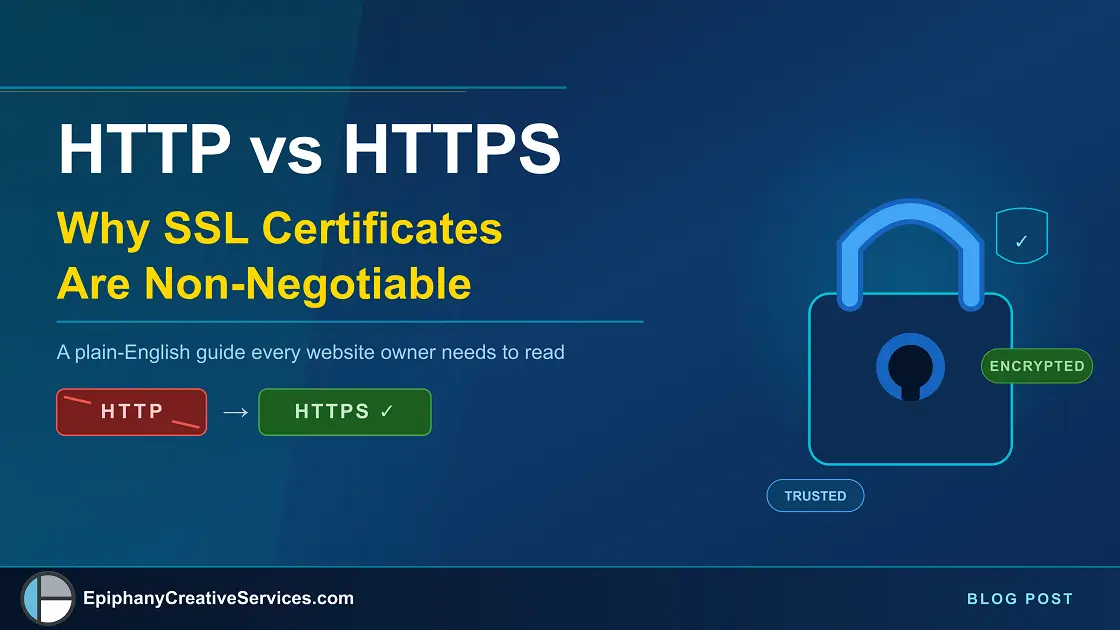

You’ve probably noticed that some websites start with ” http:// ” while others start with ” https:// “. That tiny “s” might look insignificant, but it makes a world of difference — for your visitors, your search rankings, and the future of your online presence.
In this post, I’m going to break down exactly what HTTP and HTTPS mean, why SSL certificates are no longer optional, and what happens if you ignore it. No jargon. No fluff. Just what you actually need to know.
So, What Exactly Is HTTP?
HTTP stands for HyperText Transfer Protocol. It’s essentially the language that your browser uses to talk to a web server. When you visit a website over HTTP, your browser sends a request to the server, and the server sends back the page you’re asking for.
Simple, right? The problem is — it’s completely open. Any data transferred between your visitor and your website is sent in plain text. That means passwords, credit card numbers, contact form submissions — all of it is readable by anyone who happens to be “listening” on the network.
Think of HTTP like sending a postcard. The message is written out in the open for anyone who handles it to read.
And HTTPS? What Changes?
HTTPS is HTTP with an added layer of security. The “S” stands for Secure, and it means all data transmitted between the user’s browser and your server is encrypted using SSL (Secure Sockets Layer) or its modern successor, TLS (Transport Layer Security).
What this encryption does is scramble the data so that even if someone intercepts it, they can’t read it. It’s the digital equivalent of sending a letter in a locked box — only the intended recipient has the key to open it.
And here’s the key thing: to use HTTPS, you need an SSL certificate installed on your website. No certificate, no HTTPS. It’s that simple.
Why Does This Matter for Your Website?
Let’s be honest — a lot of website owners still think SSL certificates are only for e-commerce sites or banks. That couldn’t be more wrong. Here’s why every single website needs HTTPS today:
Why Does This Matter for Your Website?
Let’s be honest — a lot of website owners still think SSL certificates are only for e-commerce sites or banks. That couldn’t be more wrong.
Here’s why every single website needs HTTPS today:
1. Your Visitors' Trust Is on the Line
Modern browsers like Chrome and Firefox now display a “Not Secure” warning in the address bar for any site that’s still running on HTTP. If a visitor sees that warning when they land on your website, the chances are they’re going to bounce immediately — and they probably won’t come back.
On the flip side, the padlock icon that appears with HTTPS sends a clear message: this site is safe. It builds instant credibility, even if your visitors don’t fully understand what SSL means technically.
2. Google Cares — A Lot
Back in 2014, Google officially announced that HTTPS is a ranking signal. That means, all else being equal, a website with HTTPS will rank higher in search results than one without it.
And it makes sense when you think about it. Google wants to send people to websites that are safe and trustworthy. A site without SSL is a red flag, and Google treats it as one.
If you’re investing in SEO — and you should be — ignoring HTTPS is like trying to run a race with one shoe on. You’re already at a disadvantage before you’ve even started.
3. It Protects Your Visitors (and Your Reputation)
Even if you don’t collect payment information, your visitors might be submitting their name, email address, or phone number through your contact form. Without HTTPS, that data is vulnerable.
A single breach or data leak can destroy years of trust you’ve built with your audience. And in some regions, there are now legal requirements around how you handle user data — failing to secure your site could land you in serious trouble.
4. It's Basically Free Now
One of the most common excuses for not having SSL used to be the cost. And fair enough — SSL certificates used to cost quite a bit of money. But today, thanks to services like Let’s Encrypt, you can get a valid SSL certificate for free.
Most reputable web hosting providers will install one for you with a single click. There’s really no excuse left.
Common Myths About SSL Certificates — Busted
- My site doesn’t collect data, so I don’t need it.” Wrong. HTTPS also verifies that your website is actually your website — not a fake copy created by a hacker. It protects the integrity of your content, not just user data.
- It will slow down my site.” This used to be partially true, but modern SSL/TLS implementations are incredibly efficient. In fact, HTTPS supports HTTP/2, which often makes sites faster.
- My host handles security, so I’m covered.” Your host secures their servers. That’s not the same as securing the connection between your site and your visitors. SSL does that.
How to Know If Your Site Is Secure
It’s actually pretty easy to check. Just look at your URL in the browser address bar:
- If it starts with https:// and shows a padlock icon — you’re good.
- If it starts with http:// or shows “Not Secure” — you need to act now.
How to Know If Your Site Is Secure
It’s actually pretty easy to check. Just look at your URL in the browser address bar:
- If it starts with https:// and shows a padlock icon — you’re good.
- If it starts with http:// or shows “Not Secure” — you need to act now.
You can also run your website through a free SSL checker tool (like SSL Labs’ Server Test) to get a detailed report on your SSL configuration and whether there are any issues.
Not Sure If Your Website Is Secure?
Look — understanding HTTPS and SSL is one thing. Actually getting it set up correctly on your website, making sure there are no mixed content errors, ensuring your redirects are configured properly, and keeping your certificate renewed on time… that’s a different story.
If you’re not 100% certain your website is fully secure and properly configured, don’t leave it to chance. A small security gap today can become a major problem tomorrow.
We Can Help — Get in Touch Today
Whether you need help installing an SSL certificate, migrating from HTTP to HTTPS, or doing a full security audit of your website — our team is here for you. Contact us now and let's make sure your website is safe, trusted, and Google-approved.Final Thoughts
The internet has changed. What was once optional is now essential. HTTPS isn’t a “nice to have” — it’s a baseline requirement for any website that wants to be taken seriously in 2024 and beyond.
Your visitors deserve to feel safe when they land on your pages. Your business deserves the trust and SEO benefits that come with it. And honestly? You deserve the peace of mind of knowing your website is doing right by the people who visit it.
If you haven’t made the switch yet, today is the day. And if you need a hand — you know where to find us.